Everything but the editor
JoyDX is a platform for defining environments, managing tools and workspaces, running app lifecycles, automating tasks, generating reports, and supporting daily SDLC work through both the CLI and GUI.
It has a wide and complex feature set designed to serve anyone working within Software Development, whether you are a developer or CTO in charge of strategy. Reduce setup friction, standardize workflows, and bring everyday engineering operations into one system; all from your own device.
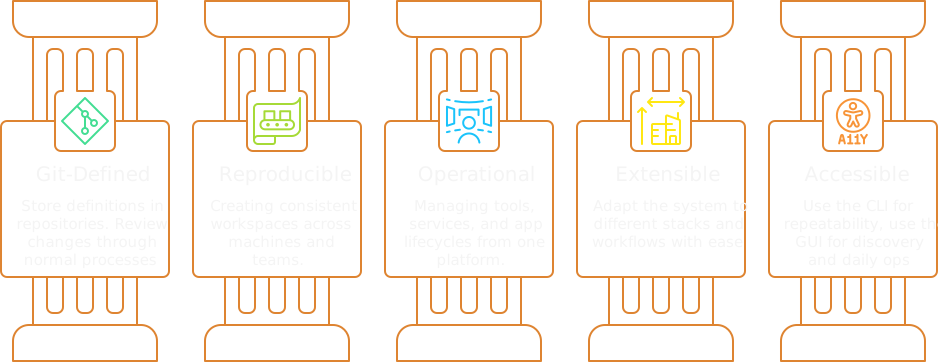
Sourcing - Bring consistency to the way development starts
JoyDX gives teams a Git-driven platform layer for defining environments, workspace behavior, roles, tooling, documentation, and lifecycle rules in simple, versioned specifications. This makes it easier to standardize how projects are sourced, prepared, and shared across teams without locking yourself into a single operating system or infrastructure model.
With reusable definitions stored in your own Git infrastructure, teams can reduce setup drift, version environment changes, and roll out standards across multiple repositories with far less duplication. Shared practices, operational knowledge, and workflow definitions stay reviewable, portable, and close to the work they support.
- Git-managed environment and workflow definitions
- Reusable standards across repositories and teams
- Consistent onboarding for project and system-level work
- Built-in support for multi-repository development models
Building - Prepare workspaces, tools, and systems with less manual effort
JoyDX simplifies the setup required before meaningful development can begin. Teams can create and manage project and system workspaces in an organized, repeatable, and isolated way, while automatically installing and managing external tools without relying on separate package managers or manual dependency tracking.
This helps developers move between machines, roles, demos, and temporary setups without rebuilding their environment from scratch. Custom system profiles make it easier to switch contexts, while standardized setup reduces support overhead and makes environments easier to maintain over time.
- Workspace management for project and system environments
- Automated tool installation and lifecycle management
- Cross-platform setup across operating systems and architectures
- Custom profiles for different roles, projects, and machine states
- Reduced setup friction for onboarding and environment changes
Development - Run day-to-day engineering work through one consistent workflow layer
JoyDX brings development activity into a unified execution model so teams can automate common tasks, run repeatable workflows, and support interactive processes from the same platform. Recipes can handle files, archives, downloads, processes, and guided execution, helping replace one-off scripts with reusable definitions that work across teams.
Developers can manage tools, services, workflows, and practical operational needs directly through JoyDX, reducing dependence on undocumented tribal knowledge. Built-in support such as secrets management, proxy services, diagnostics, and remediation guidance helps teams stay productive without constant context switching.
- Unified task automation for engineering and operational workflows
- Reusable recipes instead of ad hoc scripts
- CLI for scripting and GUI for guided execution
- Built-in operational support including secrets and proxy services
- Self-service diagnostics and environment issue resolution
Staging - Standardize quality checks, testing, and reporting before release
JoyDX supports staging and pre-launch validation by automating analysis workflows, quality checks, and reporting across repositories. Teams can run language-appropriate analyzers based on the technologies in each codebase, apply strong defaults when repository-specific rules are missing, and keep quality processes consistent through reusable recipes.
It also helps simplify more complex testing setups by tying execution to managed environments. Reports can be generated for both technical and non-technical audiences, making it easier to communicate readiness, surface issues early, and reduce the manual effort involved in inspection and review.
- Automated commit analysis and quality workflows
- Reusable analyzer recipes and standardized execution
- Strong default rulesets with configurable behavior
- Support for technical and executive-ready reporting
Packaging - Take applications from source to release from one place
JoyDX supports the full application lifecycle, including sourcing, building, running, testing, and packaging apps through a single platform layer. This reduces the need for custom scripts spread across repositories and gives teams a more consistent path from development to release preparation.
Documentation can also be automatically generated and maintained alongside workflows, helping teams keep operational knowledge aligned with the way software is actually prepared and shipped. The result is a more reliable packaging process with fewer fragmented tools and less manual coordination.
- End-to-end application lifecycle support
- Unified workflows for build, test, and package activities
- Reduced reliance on custom release scripting
- Automatically generated documentation tied to real workflows
- Better consistency between engineering processes and release outputs
Why it's different?
Most tools solve one part of the workflow. JoyDX aims to connect the full operating layer around development work from developer onboarding to pushing the production ready commit.
- Git-native by designDefinitions, artifacts, and workflow inputs live where teams already collaborate
- Broader than a dev environment managerGoes beyond setup into execution, analysis, documentation, and support operations
- More structured than ad hoc scriptsReusable definitions replace one-off local setup and hidden tribal knowledge
- More unified than a toolchain bundleConnects lifecycle tasks, diagnostics, reporting, and infrastructure-facing helpers
- Built for extensionEasy to add platforms, analyzers, tools, and engines without changing the core model
| Capability | JoyDX | Devbox / Flox | Just / Task / Make | GitHub Actions / GitLab CI | Docusaurus / Confluence | Snyk / SonarQube |
|---|---|---|---|---|---|---|
| Git-defined environments | Strong | Strong | Limited | Partial | No | No |
| Workspace management | Strong | Strong | Partial | No | No | No |
| Tool management | Strong | Partial | No | No | No | No |
| Task automation | Strong | Partial | Strong | Partial | No | No |
| App lifecycle operations | Strong | Partial | Partial | Partial | No | No |
| Analysis and reporting | Strong | No | Partial | Partial | No | Strong |
| Technical documentation | Strong | No | No | Limited | Strong | No |
| Diagnostics and remedy guidance | Strong | Limited | No | Partial | No | Limited |
| Secrets and operational support | Strong | Limited | No | Partial | Limited | Limited |
| CLI and GUI | Strong | Partial | No | Partial | Strong | Strong |
| Unified platform across these areas | Strong | Limited | Limited | Partial | No | Limited |
Comparison reflects typical native capabilities and primary use cases. Individual products may support additional workflows through extensions, integrations, or custom setup.